
Machine Learning Algorithms Made Simple: From Text to Predictions

Machine learning (ML) algorithms often sound intimidating, but once broken down into their categories and use cases, they start to look much more practical. Let’s walk through some of the most important ML algorithms—what they do, how they work, and where you’ll see them in action today.
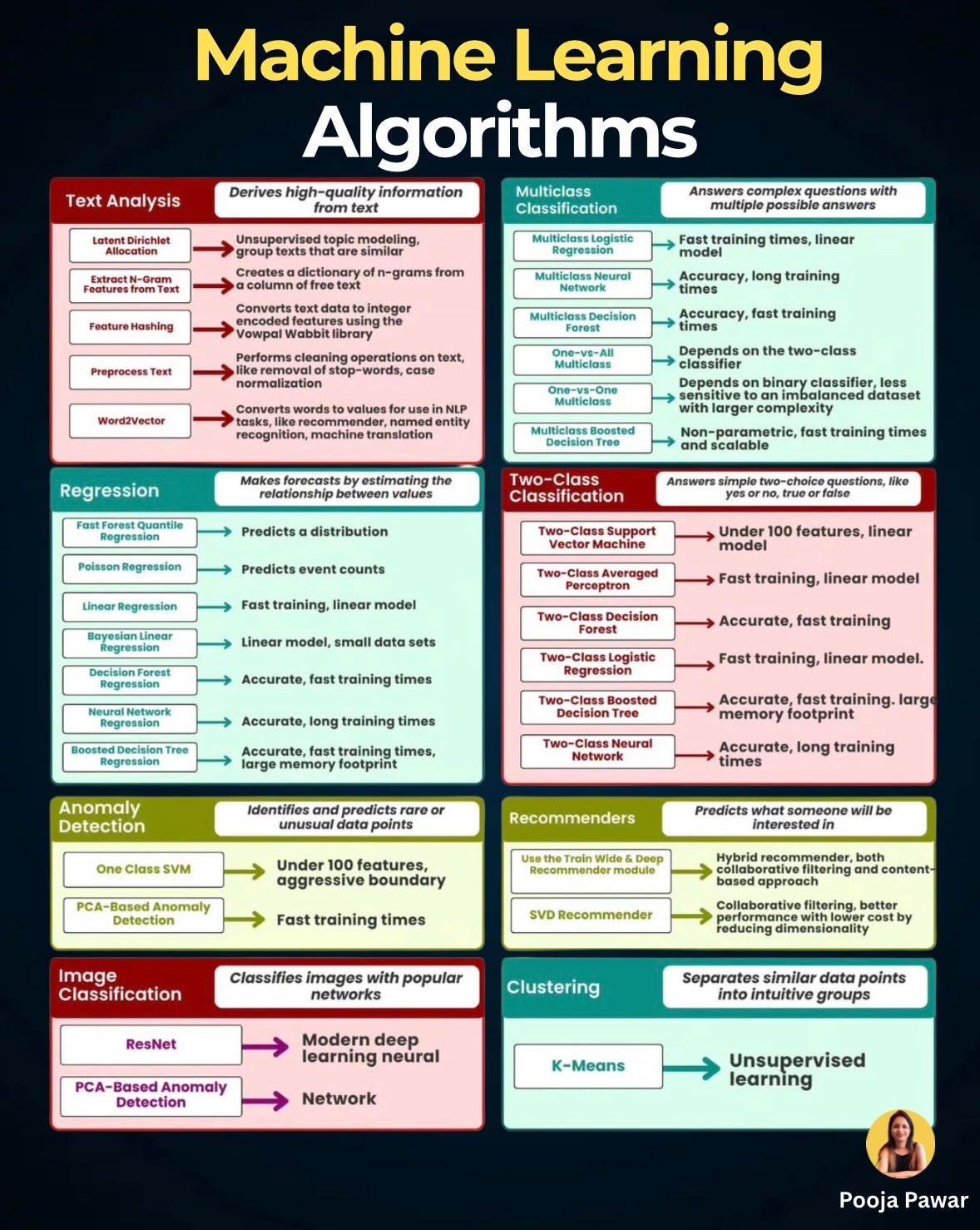
Text Analysis: Teaching Machines to Understand Words
Text analysis is about extracting meaningful insights from language.
Latent Dirichlet Allocation (LDA): Think of it as grouping news articles into topics without knowing the categories beforehand. For example, LDA can automatically identify clusters like “politics,” “sports,” or “technology.”
N-Gram Features: If you’ve seen autocomplete suggest phrases like “machine learning” after typing “machine,” that’s N-gram modeling at work.
Word2Vec: This algorithm turns words into numerical vectors, capturing their meaning. For instance, king – man + woman ≈ queen. This approach fuels translation systems, search engines, and recommendation tools.
Preprocessing: Before feeding text into models, we clean it by removing stop-words like “and” or “the.” This is why spam filters can focus on meaningful patterns such as “limited offer” or “free money.”
Modern chatbots like ChatGPT combine these text analysis techniques with neural networks to generate human-like responses.
Regression: Predicting Numbers from Data
Regression is used when the output is a number.
Linear Regression: Classic and simple—used for predicting house prices based on size, location, and amenities.
Poisson Regression: Often used for predicting counts, such as the number of cars passing through a toll booth in an hour.
Decision Forest Regression: A robust method for predicting outcomes like energy consumption across a city, factoring in many variables.
Neural Networks: Power modern applications like stock market trend predictions. They can capture complex, non-linear relationships.
Regression is everywhere—your insurance premium, Uber’s ride pricing, or Netflix predicting your watch time.
Two-Class Classification: Yes or No Problems
Here, the goal is binary decisions.
Support Vector Machines (SVM): Used in facial recognition to decide if a face matches a known identity.
Logistic Regression: A popular choice in healthcare for predicting whether a patient has diabetes (yes/no).
Decision Trees: Easy to interpret—banks use them to approve or reject loans based on credit history.
Whenever the outcome is “approve vs. deny,” “spam vs. not spam,” or “fraud vs. genuine,” you’re looking at two-class classification.
Multiclass Classification: More Than Two Choices
Not every problem is a yes-or-no. Sometimes, the machine must pick from multiple options.
Neural Networks: Used in self-driving cars to classify road signs into categories like “stop,” “yield,” or “speed limit.”
Decision Forests: Fast and scalable for problems like predicting the type of plant species based on measurements.
Logistic Regression (multiclass): For classifying emails into categories like “work,” “personal,” or “promotions.”
Social media platforms use multiclass classification to automatically tag content as text, photo, video, or advertisement.
Anomaly Detection: Spotting the Odd One Out
Anomaly detection identifies rare or unusual patterns.
One-Class SVM: Used by banks to detect unusual spending patterns that may indicate fraud.
PCA-Based Anomaly Detection: Common in manufacturing—detecting defects in products on an assembly line.
Airlines use anomaly detection to spot unusual engine behavior before it causes serious failures.
Image Classification: Teaching Machines to See
This is about recognizing and categorizing images.
ResNet (Residual Network): Powers modern computer vision tasks like identifying cats vs. dogs in photos, or diagnosing diseases from X-rays.
PCA-Based Detection: Can highlight anomalies in medical images, such as tumors.
Your smartphone’s gallery automatically grouping pictures of the same person uses image classification.
Clustering: Making Sense of Groups
Clustering groups similar data points together—without predefined labels.
K-Means: Imagine a mall analyzing customer purchase data and grouping shoppers into “budget buyers,” “brand lovers,” and “impulse shoppers.”
Unsupervised Learning: Often used in marketing to segment audiences for targeted ads.
Spotify groups similar songs and recommends playlists using clustering algorithms.
Recommenders: Predicting What You’ll Like Next
Recommendation systems are one of the most practical uses of ML.
SVD Recommender: Collaborative filtering—Netflix recommends movies based on what people with similar taste enjoyed.
Wide & Deep Models: Combine broad patterns with fine-grained personalization, making YouTube’s video suggestions remarkably accurate.
E-commerce platforms use hybrid recommenders that consider both your past purchases and trending products.
Machine learning isn’t just about math and theory—it powers the apps and services we use daily. From predicting what you’ll watch next on Netflix to helping doctors detect diseases earlier, these algorithms quietly shape our digital lives.
Instead of trying to learn every algorithm at once, focus on their applications. Ask yourself: What problem does this algorithm solve in the real world? Once you connect theory to practice, concepts become easier to grasp—and more exciting.
++ Good Post. Also, start here : 500+ LLM, RAG, ML System Design Case Studies, 300+ Implemented Projects, Research papers in detail
https://open.substack.com/pub/naina0405/p/most-asked-ml-system-design-case-ada?r=14q3sp&utm_campaign=post&utm_medium=web&showWelcomeOnShare=false