
Top Languages Every Data Analyst Should Know

Data analysis is more than just crunching numbers—it’s about telling a story with data. To do that effectively, analysts rely on programming languages that offer speed, flexibility, and powerful tools. Let’s break down the top languages for data analysts, why they matter, and where each language shines with examples from real-world scenarios.
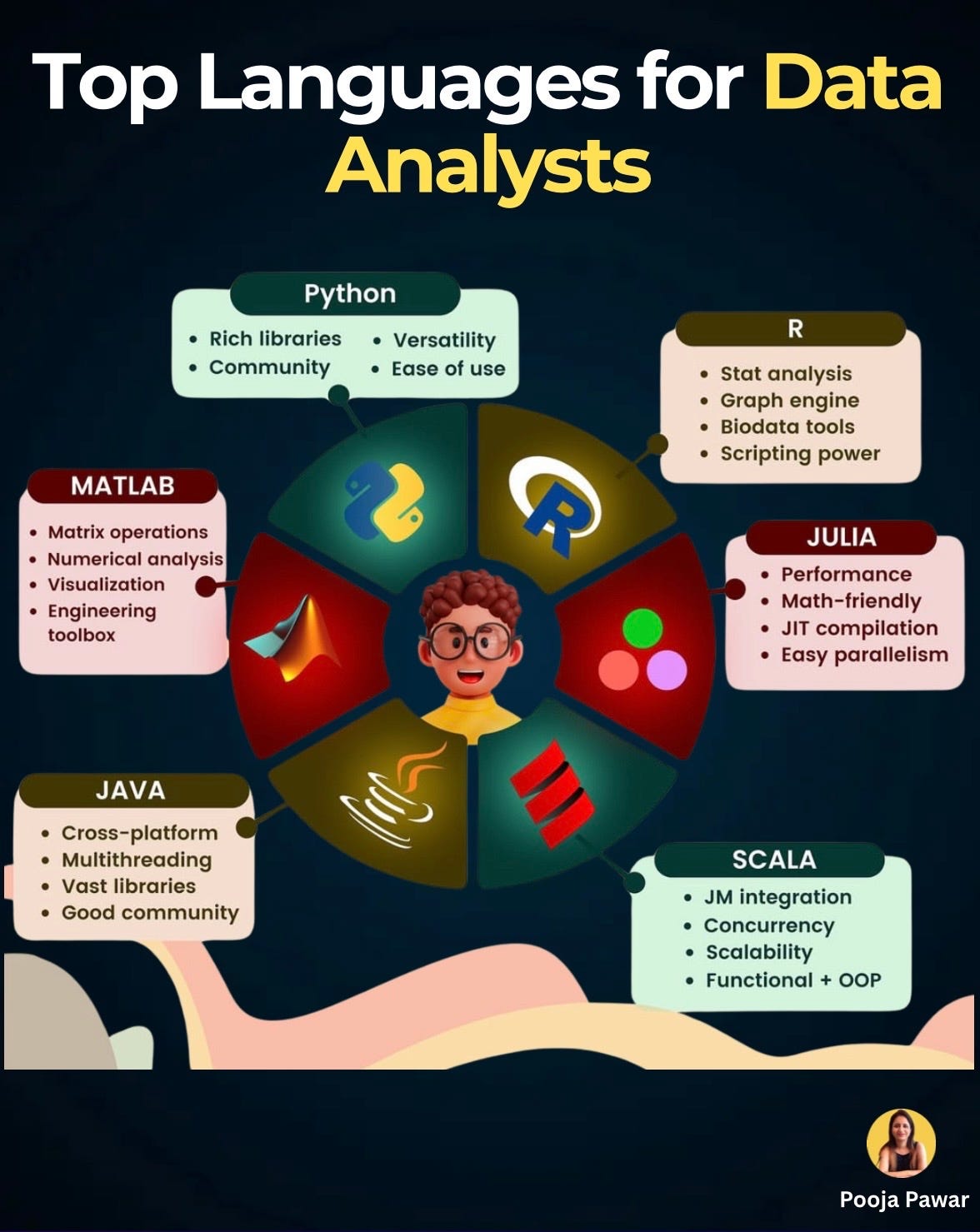
Python: The Swiss Army Knife of Data
Python dominates the analytics space because of its rich libraries, versatility, and ease of use. Whether it’s data cleaning with Pandas, visualization with Matplotlib/Seaborn, or building predictive models with scikit-learn, Python provides an end-to-end ecosystem.
Example: An e-commerce company can use Python to analyze customer purchase histories, segment users, and recommend products through machine learning models.
Beginners should start with Pandas and NumPy before diving into machine learning.
R: The Statistician’s Favorite
R is purpose-built for statistical analysis and comes packed with tools for visualizing and modeling complex data. Its ggplot2 package is still a benchmark for creating professional-quality graphs.
Example: A healthcare analyst might use R to analyze patient survival rates across different treatments, applying regression and survival models.
Did you know? R was one of the first languages to integrate with biostatistics tools, making it invaluable in fields like genetics and epidemiology.
MATLAB: Precision for Numerical Work
While MATLAB is often associated with engineers, it’s also a solid choice for analysts who deal with matrix operations, numerical simulations, and advanced visualization.
Example: An automotive company could use MATLAB to simulate fuel efficiency models under different driving conditions.
Many universities still teach MATLAB in engineering courses because of its extensive “engineering toolbox.”
Julia: The Rising Star
Julia is gaining popularity thanks to its performance, math-friendly syntax, and ability to handle parallel computing. It combines the simplicity of Python with the speed of low-level languages like C.
Example: A financial analyst could use Julia to run real-time risk simulations involving millions of data points—something Python might handle slower.
Julia’s popularity has been growing in academic research where large-scale simulations are required.
Java: Rock-Solid and Scalable
Java may not be as trendy as Python, but its cross-platform stability, vast libraries, and multithreading support make it a strong contender for big data projects.
Example: Banks and insurance firms often use Java-based frameworks like Hadoop for large-scale fraud detection and claims analysis.
If you’re working with enterprise-level applications, knowing Java can make you stand out.
Scala: Power Behind Big Data
Scala combines functional programming with object-oriented principles, making it the backbone of many big data frameworks like Apache Spark.
Example: A streaming service like Netflix can process millions of user interactions in real time using Spark + Scala to recommend shows.
Scala’s concurrency model makes it excellent for projects where scalability and speed are non-negotiable.
Each language has its strengths.
Python: General-purpose, versatile, beginner-friendly.
R: Best for statistics-heavy work.
MATLAB: Strong in numerical and engineering domains.
Julia: Fast, parallel, and research-friendly.
Java: Reliable for enterprise-scale analytics.
Scala: Critical for real-time big data processing.
Instead of trying to learn them all at once, align your learning with your career goals. For example, if you want to work in healthcare research, R is your best bet. For finance, Julia or Python could be more relevant. For big data roles, Scala or Java is essential.