
Types of Databases Every Analyst Should Know

Databases are the backbone of the digital world. From your social media feed to banking apps, almost everything you interact with relies on a well-designed database. But not all databases are built the same. Some are optimized for structured financial records, while others are tailored for handling massive real-time event streams. Let’s break down the major types of databases — with theory, real-world use cases, and practical insights.
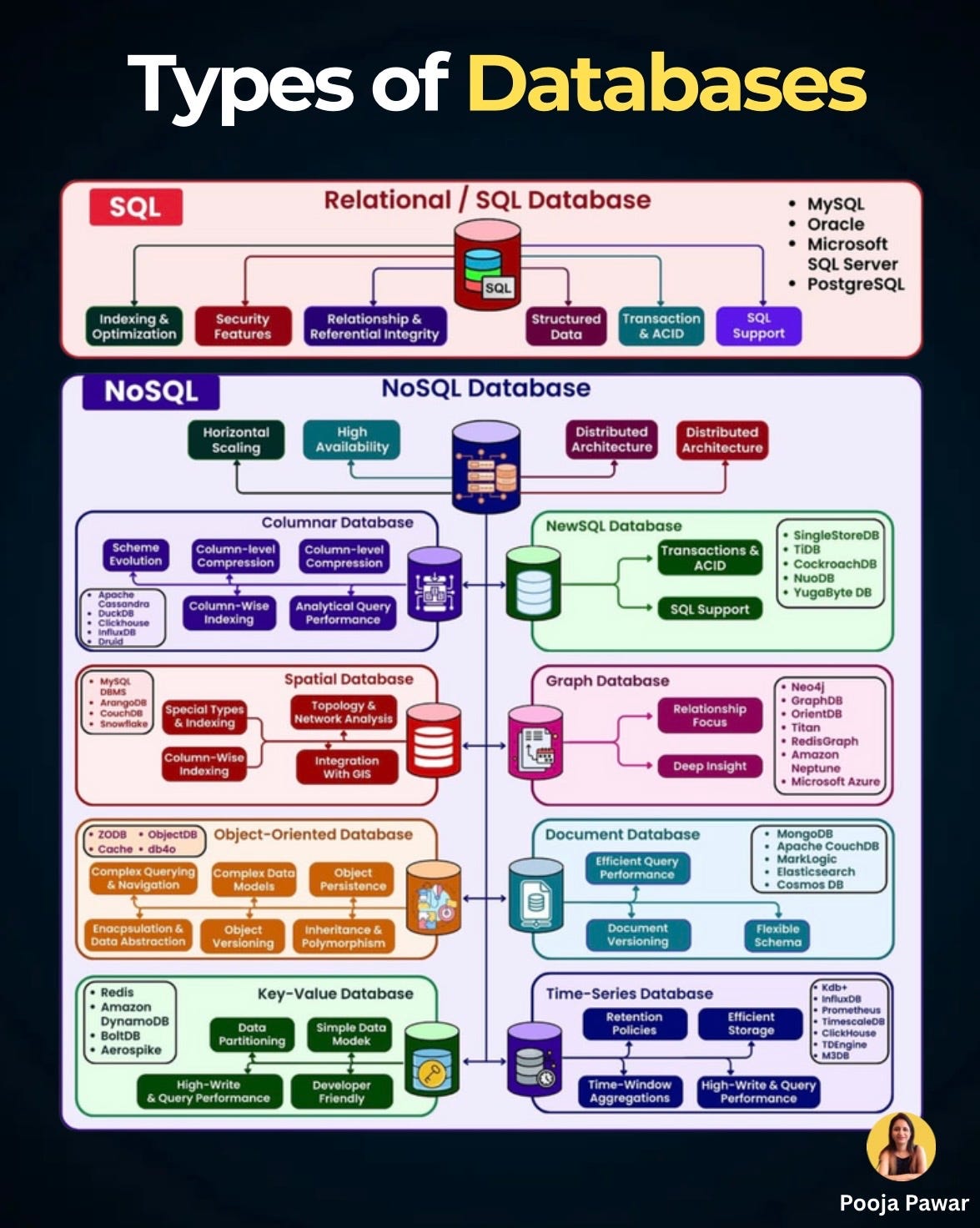
Relational / SQL Databases
Relational databases are the workhorses of the data world. They organize data into tables with rows and columns, using Structured Query Language (SQL) to retrieve and manipulate information.
Core features:
Relationships and referential integrity between tables
Strong security controls
Support for ACID transactions (Atomicity, Consistency, Isolation, Durability)
Examples: MySQL, PostgreSQL, Oracle, Microsoft SQL Server
Where you see them in action:
Banking systems tracking every deposit and withdrawal
HR systems storing employee records and payroll
E-commerce platforms managing inventory and orders
SQL databases are unbeatable when data is highly structured and needs consistency, like financial reporting or healthcare records.
NoSQL Databases
As the name suggests, NoSQL goes beyond traditional relational models. These databases are designed for flexibility, scalability, and handling unstructured or semi-structured data.
Key strengths:
Horizontal scaling (easy to add servers as data grows)
High availability across distributed systems
Flexible schemas
NoSQL databases come in several flavors, each serving a specific purpose.
Columnar Databases
Think of columnar databases as Excel on steroids — they store data by columns rather than rows, which makes analytical queries lightning fast.
Examples: Apache Cassandra, HBase, ClickHouse
Use cases:
Analytics dashboards needing fast aggregate queries
Telecom call detail records
Financial risk analysis
Document Databases
Document stores keep data in flexible JSON-like documents instead of rigid tables. They shine when dealing with evolving or nested data.
Examples: MongoDB, CouchDB, Cosmos DB, Elasticsearch
Use cases:
Content management systems (blogs, product catalogs)
Mobile apps where data formats keep changing
Search engines indexing vast amounts of text
Key-Value Databases
These are the simplest form of databases — data is stored as key-value pairs, much like a dictionary.
Examples: Redis, Amazon DynamoDB, BoltDB
Use cases:
Caching results to speed up applications
Session management in web apps
Leaderboards in gaming apps
Redis powers real-time analytics for platforms like Twitter and GitHub.
Graph Databases
Graph databases model data as nodes (entities) and edges (relationships), making them ideal for analyzing complex connections.
Examples: Neo4j, Amazon Neptune, Microsoft Azure Graph DB
Use cases:
Social networks mapping friendships and likes
Fraud detection in financial services
Recommendation engines (Netflix suggesting shows based on your watch history)
Time-Series Databases
Optimized for timestamped data, these databases are perfect for scenarios where data changes over time.
Examples: InfluxDB, TimescaleDB, Kdb+
Use cases:
IoT sensors streaming real-time data
Stock market tick data
Server performance monitoring
Tip: If your data arrives as a continuous stream, a time-series database helps you keep queries efficient without bloating your system.
Spatial Databases
Spatial databases add intelligence to location data, storing coordinates, maps, and geometry.
Examples: PostGIS, Oracle Spatial, Snowflake with GIS integration
Use cases:
Ride-sharing apps like Uber (matching drivers with riders)
Logistics companies optimizing delivery routes
Urban planners analyzing city layouts
Object-Oriented Databases
These merge programming concepts with database design by storing objects rather than just rows and columns.
Examples: db4o, ObjectDB, ZODB
Use cases:
CAD software storing engineering designs
Multimedia applications managing images, videos, and 3D objects
NewSQL Databases
NewSQL blends the strengths of relational databases (ACID compliance, SQL support) with the scalability of NoSQL. It’s like the best of both worlds.
Examples: TiDB, CockroachDB, NuoDB
Use cases:
High-traffic applications like online payment gateways
Real-time bidding in advertising platforms
Cloud-native apps needing both scale and consistency
Latest Trends to Watch
Cloud-native databases: Services like Amazon Aurora and Google Spanner are making scalability easier than ever.
AI + Databases: Integration of machine learning directly into databases is growing (e.g., PostgreSQL ML extensions).
Multi-model databases: Systems like ArangoDB can act as document, key-value, and graph databases at once.
For startups, NoSQL often provides agility to move fast, while established enterprises lean toward SQL or NewSQL for reliability. A hybrid approach is now common — using SQL for critical systems and NoSQL for scalable, customer-facing apps.
Choosing the right database isn’t about which one is “best” overall — it’s about which one is best for the problem at hand. A fintech company might rely heavily on relational databases for compliance, but also use a time-series database for analyzing trades in real time. Similarly, an e-commerce platform could mix SQL for inventory, NoSQL for customer reviews, and graph databases for recommendations.
Databases are no longer just back-end infrastructure; they’re strategic tools that shape how organizations innovate, scale, and compete in the digital era.
Graph databases are based on graph theory, so the nodes in the database will have edges connecting to each other directly. Queries can be performed without the need of expensive join operations or foreign keys. This makes them a good choice for large data sets and data with changing or hard to define schemas.
Real Life Examples:
Fraud detection
Searching algorithms
Social networking
Geospatial intelligence